
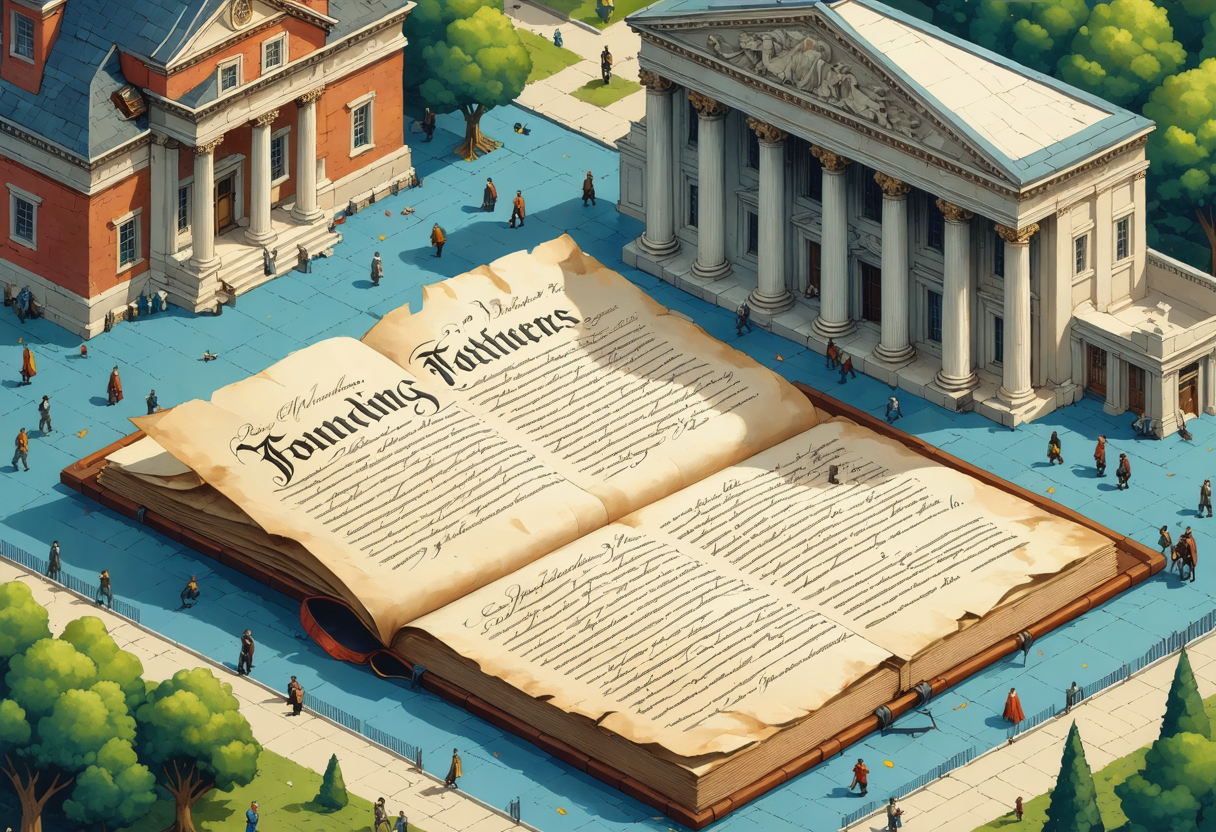
The world of the American Founding Fathers was one of letters, pamphlets, and slow, deliberate debate. Information traveled at the speed of a horse, and the months-long public discourse over The Federalist Papers stands in stark contrast to a modern political firestorm that can erupt and exhaust itself on social media within hours. Theirs was a political environment built on reflection, designed to create a system insulated from the passions of the moment. The United States was established as a “constitutional republic,” a framework designed to be a nation of laws, not what one commentator’s grandfather, a medical doctor and history buff, memorably called “mob rule.”
Fast forward to the 21st century, where political discourse unfolds in our fragmented, algorithmically-driven information ecosystem. Our modern public square is governed by algorithms, amplified by influencers, and defined by the viral spread of information—and misinformation. How does the founders’ vision for America hold up in an age where policy debates are reduced to 280 characters and elections are shaped by TikTok trends? This clash of eras reveals three surprising takeaways about the state of their great experiment.


The Digital Mob vs. The Deliberate Republic
The Founding Fathers intentionally designed a system meant to be slow. They built in checks and balances to cool the passions of the public and prevent the rise of mob rule, ensuring that laws were the result of careful consideration, not popular outrage. Today’s social media environment presents a direct challenge to that core principle. It is an architecture designed to optimize for engagement, which invariably means amplifying emotion and outrage. This creates a volatile feedback loop where outrage is currency, and politicians are incentivized to react to the digital tide rather than engage in legislative deliberation.
This digital pressure cooker is having a measurable effect. According to a report from NewsChannel 9 in Syracuse, the public is feeling the strain, noting that “both sides of the political spectrum appear to be feeling the stress circulating around the election.” The stakes feel impossibly high, creating an environment of perpetual crisis rather than reasoned debate. As political science professor Joel Kaplan observes about his students:
“They’ve been told that it’s the difference between democracy and autocracy. They’ve been told between, you know, reproductive choice and no choice. So I think it’s starting to like, weigh on them a little bit.”
This constant, high-stakes emotional environment creates a kind of “digital mob” that demands immediate action and reaction. It is a force that runs directly counter to the founders’ vision of a republic that values slow, reasoned, and deliberative governance.
Influencers as the New Pamphleteers
In the revolutionary era, influential writers used the media of their day—pamphlets and essays—to shape public opinion and mobilize support for their cause. Documents like The Federalist Papers, written by Alexander Hamilton, James Madison, and John Jay, were created specifically to persuade the public and encourage the approval of the Constitution. These men were, in effect, the political influencers of their time.
Today, that role has been inherited by a new generation using vastly different platforms. Gen Z, for example, obtains most of its information about candidates from social media sites like TikTok and YouTube. Just as the pamphleteers of old, today’s social media influencers are “speaking out on issues” and empowering their followers. Academic research confirms this parallel, noting that social media has “dramatically changed the flow of information” and plays a “key role in circulating news… beyond national borders.” More specifically, this new media landscape is a powerful tool used “for campaigning and for mobilizing social movements.”
As Syracuse University student Sophia Abdullina notes, this connection is direct and personal:
“There’s a lot of influencers that I personally watch that speak out on issues, and I think that because Gen Z is so vocal about issues, they’re able to connect to everyone.”
While the technology has evolved from the printing press to the smartphone, the fundamental function is a clear echo of the founders’ own tactics. Using media to shape opinion, educate the public, and mobilize citizens for political action is a tradition as old as the republic itself.
The Founders’ Flaws Would Go Viral
It is a crucial historical fact that the Founding Fathers “weren’t perfect people.” Their vision for liberty and independence was built upon staggering contradictions. Their major flaws included “encouraging and participating in the enslaving of african people, continuing the mistreatment of indigenous people, and ignoring the rights of women.”
In the modern social media landscape, these undeniable actions would not be historical footnotes debated by academics. They would become explosive hashtags, subject to digital pile-ons as their legacies would be deconstructed in countless viral threads. The carefully constructed images of these men would be dismantled and examined through a critical lens they could never have imagined. This constant re-litigation of historical figures on social media isn’t just about the past; it’s a battleground for present-day values, where historical figures are used as proxies in our ongoing culture wars.
This doesn’t erase their accomplishments, but it places them in a starker context. As one educational source puts it, “when we celebrate the amazing things the founding fathers did, we also recognize that they weren’t faultless.” Social media would ensure that this recognition was not just an afterthought, but a central and unavoidable part of the conversation.
An Experiment in Progress
The collision of the founders’ 18th-century ideals with 21st-century technology reveals a core tension. Social media simultaneously undermines their vision for a slow, deliberate republic while also amplifying the very citizen engagement and political participation they hoped to inspire. It is both a threat to their system and a powerful expression of its democratic spirit.
The founders created a system designed to last for centuries, but they could never have imagined a world connected by clicks and code. The question for us is, can their republic survive its encounter with the digital world, or will it be fundamentally remade by it?