


1. Introduction: The Disconnect and the Re-Coding
There is a profound disconnect running through modern society. We participate in the theater of democracy—casting ballots, debating politics, and arguing over “left vs. right”—yet the levers of power increasingly feel distant, automated, and out of reach.
This is not necessarily a failure of the original American system. It is the perception that the system has been gradually re-coded.
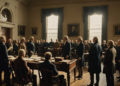

The Founding Fathers envisioned a republic built on civic virtue, limited government, and checks on centralized authority. Today, many believe that vision has been overshadowed by a transnational architecture of debt, data, and institutional power.
The struggle is no longer simply the individual versus the state. It is the individual versus the Complex.
To understand where we are headed, we must first understand where we came from—and why the choices made by the Founders still matter.
2. George Washington’s Greatest Victory Was Quitting
In the eighteenth century, power was something to be seized and held. History rewarded conquerors, kings, and strongmen who accumulated authority and refused to surrender it.
George Washington chose a different path.
While commanding the Continental Army, Washington repeatedly emphasized that military service did not erase citizenship. In 1775, he reminded the New York Provincial Congress that when Americans assumed the role of soldier, they did not lay aside the role of citizen.
That principle became one of the defining moments of the American experiment.
When the Revolutionary War ended, Washington voluntarily surrendered his commission and returned to private life. This act shocked the world. Leaders throughout history had fought wars to gain power. Washington fought a war and then willingly gave power away.
Even King George III reportedly remarked that if Washington truly returned to private life, he would be “the greatest man in the world.”
Washington’s resignation established a tradition that military power would remain subordinate to civilian government. In many ways, his decision to quit was one of the greatest victories of the American Revolution.
In an age of career politicians, permanent bureaucracies, and endless conflicts, Washington’s example remains one of the most radical demonstrations of American sovereignty ever witnessed.
3. The Financial Complex as the New Base Layer of Authority
The Founders feared monopolies, mercantile interests, and concentrated power. Their concern was that economic influence would eventually overwhelm political accountability.
Many critics argue that modern power structures have evolved into something even more complex.
While public attention is often focused on elections and political parties, power increasingly appears embedded within interconnected systems:
Financial Industrial Complex (FIC)
The financial system sits at the foundation of modern society. Debt, credit creation, bond markets, and monetary policy influence nearly every aspect of government and economic activity.
Military-Industrial Complex (MIC)
First warned about by President Dwight D. Eisenhower, this network of defense contractors, military spending, and strategic interests benefits from the continuation of global conflict and geopolitical competition.
Technological Industrial Complex (TIC)
The newest layer consists of data collection, algorithms, artificial intelligence, digital surveillance, and media ecosystems that increasingly shape public perception and behavior.
Together, these systems form what many describe as an “Invisible Crown”—a structure where power flows through institutions rather than elected offices alone.
Under this framework, governments manage public narratives while larger systems influence the economic realities beneath them.
4. The Newburgh Conspiracy and the Theater of Sacrifice
The American experiment nearly collapsed before it truly began.
In March of 1783, officers within the Continental Army grew frustrated by Congress’s inability to pay them. Some considered using military pressure to force political change.
The situation became known as the Newburgh Conspiracy.
Washington responded not with threats or force, but with humility.
Addressing the officers, he reached for a pair of spectacles and quietly remarked that he had grown not only gray but almost blind in service to his country.
For many of the officers present, it was the first visible reminder of the personal sacrifices Washington had made throughout the war.
The tension dissolved.
Rather than pursuing personal grievances, the officers recommitted themselves to the civilian republic they had fought to create.
The lesson remains powerful today. The survival of free societies often depends less on force and more on restraint, character, and the willingness to place principles above personal gain.
5. The “Suez Moment” and the Managed Transition
Throughout history, great powers have experienced moments when their dominance began to fade.
For the British Empire, many historians point to the Suez Crisis of 1956 as a symbolic turning point.
Some observers believe the United States may be approaching a similar moment.
America faces rising debt, political division, demographic challenges, and increasing competition from emerging powers. At the same time, organizations such as BRICS and regional economic alliances are working to build alternatives to long-standing Western institutions.
From this perspective, the global system appears to be moving from a unipolar world toward a multipolar one.
Events in strategic locations such as the Strait of Hormuz are watched closely because disruptions there could have significant consequences for energy markets, currencies, and international trade.
Whether these developments represent decline, transition, or transformation remains open to debate.
What is clear is that the global balance of power is changing.
6. The Paradox of the Corporate Citizen
Modern citizens occupy a strange and often uncomfortable position.
Many people depend on retirement accounts, investment funds, and financial markets to secure their future. Yet those same institutions are often criticized for concentrating power and influence.
The result is a paradox.
The average citizen is simultaneously a beneficiary of the system and a critic of it.
Large asset managers such as BlackRock, Vanguard, and State Street control enormous amounts of capital and hold ownership stakes across much of the global economy.
To some observers, this concentration resembles the monopolistic structures that early Americans sought to avoid.
The irony is difficult to ignore.
Communities often struggle with economic uncertainty, declining social trust, and rising costs, while financial markets continue to expand.
The challenge for citizens is determining how to participate in the modern economy without surrendering the principles of self-government, local accountability, and civic responsibility.
7. The Exit Strategy: From Dependency to Sovereignty
Every era produces its own version of independence.
For the Founders, independence meant separation from a distant crown.
For many modern advocates of decentralization, independence means reducing reliance on centralized systems.
This philosophy emphasizes personal responsibility, financial literacy, local community building, and ownership of assets.
Supporters of decentralized technologies view tools such as Bitcoin, self-custody, and peer-to-peer networks as modern mechanisms for increasing individual autonomy.
The broader argument is not simply about technology.
It is about restoring the ability of individuals to make choices without excessive dependence on centralized institutions.
Whether one agrees with these solutions or not, the underlying concern remains the same: preserving freedom in an increasingly interconnected and automated world.
As one popular phrase suggests:
“The way we win is decentralized technology versus centralized technology, and decentralized communities versus centralized communities.”
Conclusion: A Legacy to Safeguard, Not Just Rewrite
The Founders never intended their work to become a relic preserved behind glass.
The American experiment was designed to be an ongoing test of whether free people could govern themselves while resisting the natural tendency of power to concentrate.
Today, the threats may look different than they did in 1776.
The challenge is no longer a crown in London. For many, it is the growing influence of debt, bureaucracy, technology, and institutions that operate beyond the visibility of ordinary citizens.
The central question remains unchanged.
Can citizens maintain meaningful control over their future, or will increasingly complex systems make those decisions for them?
The American experiment has survived wars, depressions, corruption, political upheaval, and technological revolutions. Its future may ultimately depend on whether citizens remain active participants in self-government or become passive consumers within systems they no longer control.
The mandate remains the same: vigilance, responsibility, and the continual defense of liberty.
Final Thought
In an age of expanding institutions, growing debt, and increasingly automated systems, what responsibility does the individual citizen still have—and what does genuine sovereignty look like in the twenty-first century?