


1. The Forest and the Fleet
At first glance, a family of predators navigating a dense forest and a nuclear-powered naval fleet appear to be polar opposites. One is the result of millions of years of biological evolution, while the other is the pinnacle of modern systems engineering.
Yet both operate according to a similar logic of power, shaped by the harsh realities of survival, limited resources, communication, and protection.

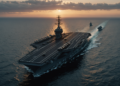
The true strength of either system does not depend entirely on the physical dominance of a single individual or vessel. Instead, both function as complex, integrated ecosystems made up of specialized components working toward a common objective.
A wolf pack is not powerful simply because it contains a strong wolf. A naval fleet is not powerful simply because it contains an aircraft carrier.
Their strength comes from the system surrounding them.
By examining specialization, cooperation, communication, logistics, and redundancy, an interesting pattern emerges: power is not merely a product of individual strength. It is the result of coordinated strength.
2. Beyond the “Alpha”: Leadership Is More Complicated Than Dominance
The popular concept of the “alpha wolf”—a dominant tyrant ruling the pack through aggression—largely grew from observations of unrelated wolves placed together in captivity.
Under those artificial conditions, wolves formed dominance hierarchies that did not necessarily reflect the way normal wolf packs operate in the wild.
Wolf biologist David Mech, whose early work helped popularize the term “alpha wolf,” later argued that the label was misleading when applied to natural wolf packs. In the wild, a typical pack is primarily a family: breeding parents and their offspring.
That changes the entire interpretation of leadership.
The wolves at the center of the pack are not necessarily ruling because they defeated every challenger. In many cases, they are leading for the same reason human parents lead a family: they are the experienced adults responsible for feeding, protecting, teaching, and guiding younger members.
Aggression can certainly occur. Wolves are predators, not cartoon characters. But reducing the entire social structure of a wolf pack to “the strongest wolf dominates everyone else” misses something much more interesting.
Leadership can come from responsibility rather than domination.
That distinction matters when comparing biological systems with human organizations. A successful leader does not always need to be the strongest component in the system. Sometimes leadership means understanding how the different components fit together and keeping the entire structure functioning.
3. The Speed of the Slowest: A Pack Cannot Abandon Its Own
There is a popular image circulating online that supposedly shows wolf packs traveling in a rigid formation, with the oldest and weakest wolves at the front, stronger wolves positioned around the middle, and the “alpha” deliberately walking at the rear.
That exact formation should be treated cautiously. Wolves do not appear to follow a universal military-style marching order every time they travel.
But the larger principle behind the image remains interesting.
A family group cannot simply operate as though every member has identical capabilities.
Young wolves, injured wolves, older animals, breeding adults, and experienced hunters may all have different physical limitations and different roles. The pack must continually adjust to those realities.
This creates an important systems principle:
The sustainable speed of a group is often determined by the components it cannot afford to lose.
Humans encounter the same problem everywhere.
A convoy cannot simply travel at the maximum speed of its fastest vehicle. A military formation cannot plan entirely around its strongest unit. A supply chain cannot operate faster than its critical bottleneck will allow.
The goal is not necessarily to make every component equally powerful.
The goal is to keep the system intact.
That is a very different definition of strength.
4. The Carrier Is Powerful Because It Is Not Alone
Now move from the forest to the ocean.
A U.S. Navy carrier strike group is one of the most powerful military formations humans have ever constructed. At its center is an aircraft carrier capable of projecting enormous air power across hundreds of miles.
Yet the carrier itself tells only part of the story.
A carrier is extraordinarily valuable precisely because it performs a specialized job extremely well. That specialization also creates vulnerabilities.
It therefore operates as part of a larger system.
Destroyers and other escorts contribute air defense, anti-submarine warfare, surface warfare, sensors, communications, and additional weapons. Attack submarines may operate in support of the larger mission. Logistics ships provide the fuel, ammunition, food, spare parts, and supplies required to keep the force operating far from home.
The aircraft carrier may be the most visible component, but visibility should not be confused with independence.
Take away the escorts.
Take away the submarines.
Take away airborne surveillance.
Take away communications.
Take away logistics.
Eventually, the mighty carrier stops being a global power-projection system and becomes an extremely expensive ship with increasingly limited options.
Its real power exists in the network.
5. Cooperation Is a Force Multiplier
Wolves demonstrate the same principle during cooperative hunting.
A single wolf can be dangerous, but wolves working together can pressure prey in ways that an individual animal cannot. Different animals can approach from different directions, maintain pursuit, exploit openings, and influence where the prey attempts to escape.
Not every wolf has to make the final strike.
One wolf’s position can change the prey’s direction.
Another can maintain pressure.
Another may exploit the opening created by the others.
The individual actions become parts of a larger system.
Naval warfare works on the same basic principle, although the technology is obviously far more complicated.
One platform detects something.
Another identifies it.
Another tracks it.
Another may be positioned to engage it.
Aircraft extend the fleet’s reach into the sky. Surface ships provide additional sensors and weapons. Submarines create an underwater threat an enemy must account for even when it cannot see them.
This creates something more powerful than any individual platform.
The advantage is not making everything identical. It is combining different capabilities toward the same objective. Cooperation multiplies power.
Nature figured that out long before humans gave it names such as “combined arms,” “network-centric warfare,” or “force multiplication.”
6. The Most Important Members May Not Be the Most Dangerous
There is another lesson hidden inside both systems.
The most dangerous component is not necessarily the most important component.
For a wolf pack, reproduction determines whether the family continues into another generation. Pups are almost useless as hunters and defenders, yet they represent the future of the entire system.
That makes protecting and feeding them strategically important.
The same principle appears in military logistics.
A replenishment ship does not have the visual intimidation of an aircraft carrier. A tanker does not attract attention like a destroyer launching missiles. Supply crews rarely become the symbols used on recruiting posters.
But remove the fuel.
Remove the ammunition.
Remove the food.
Remove replacement parts.
Remove maintenance.
Eventually, the fighting stops.
A warship without fuel, ammunition, food, maintenance, or replacement parts does not remain combat-effective simply because it possesses advanced weapons.
This is one of the oldest lessons in warfare: combat power is limited by the system that sustains it.
The glamorous part of the system gets the attention.
The unglamorous part keeps it alive.
7. The Power of What You Cannot See
Both systems also contain another interesting form of power: uncertainty.
Wolves do not always remain tightly packed together. Individuals may scout, disperse, patrol territory, or move beyond the immediate family group.
Their absence does not necessarily mean they are irrelevant.
Sometimes not knowing exactly where a threat is located creates its own form of pressure.
Modern naval warfare takes this principle to an extraordinary level with submarines.
A nuclear-powered attack submarine does not need to advertise its position to influence an opponent’s behavior. In fact, revealing its position defeats much of its purpose.
Its strength comes partly from uncertainty.
Where is it?
What is it tracking?
How close is it?
What could it strike?
An enemy must account for the possibility even without knowing the answer.
That creates psychological and strategic pressure without requiring visible force.
The aircraft carrier demonstrates power by being seen.
The submarine demonstrates power by disappearing.
Both contribute to the same larger system in completely different ways.
8. Redundancy Is Not Waste—It Is Survival
Modern organizations often treat redundancy as inefficiency.
Why have multiple systems capable of performing similar tasks?
Why maintain backups?
Why spend resources protecting against something that may never happen?
Nature provides a simple answer.
Because failure happens.
An injured wolf may temporarily lose its ability to hunt. A hunting attempt may fail. Prey may disappear from an area. Weather may change. Territory may become dangerous.
Survival requires adaptation.
Military systems face the same reality.
Aircraft malfunction.
Sensors fail.
Ships require maintenance.
Communication links can be disrupted.
Weapons can miss.
Supply routes can be interrupted.
A system built around one perfect component has a catastrophic weakness: that component cannot be allowed to fail.
A resilient system assumes failure is possible and builds alternatives around it.
That may appear inefficient when everything is working perfectly.
It becomes priceless the moment something stops working.
9. Strategy Is Just a Human Word for Survival
The parallels between wolf packs and naval fleets reveal a larger principle.
True power comes from specialization, communication, cooperation, logistics, adaptation, and shared purpose.
Individual strength still matters. A powerful wolf is useful. A powerful destroyer is useful. A carrier loaded with aircraft represents tremendous combat capability.
But individual power reaches a limit.
Systems multiply it.
Humans call this strategy, logistics, command and control, force multiplication, combined operations, and systems engineering.
Nature simply calls it survival.
Long before humans built fleets, communication networks, military organizations, or global supply chains, biological systems were already solving many of the same fundamental problems.
How do specialized members cooperate?
How do you protect vulnerable but essential components?
How do you distribute limited resources?
How do you survive the loss of an individual member?
How do you detect danger before it reaches the center?
How do you make the entire group more capable than any individual inside it?
Nature has been experimenting with those questions for millions of years.
Perhaps our most advanced systems are not as uniquely human as we imagine.
Maybe we did not invent the logic at all.
Maybe we simply learned how to build it out of steel.


