


Imagine a scene from nearly any classic anime: the sun is a white-hot orb, the pavement shimmers with a mirage-like haze, and a character traverses a quiet residential street. Before a single syllable of dialogue is uttered, a monolithic wall of sound descends. It is a rhythmic, metallic drone—a visceral, piercing miiiiiiiiiiiiin… miiiiiiiiiiiiin.
Whether you are navigating the high-stakes existentialism of a mecha pilot or the mundane domesticity of a high school student, this auditory signature is the universal herald of the Japanese summer.
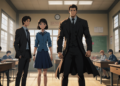

To the uninitiated, it is merely background texture. To the critic, it is a fascinating case study in how a singular, uncanny uniformity has dominated a medium for decades.
Why does every anime summer sound identical, and how did a technical shortcut evolve into a profound philosophical shorthand?
1. The “Ghost” Recording of 1977
The ubiquity of this soundscape isn’t merely a coincidence of nature. It is rooted in a specific technical legacy.
While modern studios have access to vast digital libraries, a staggering amount of the audio we hear is a “ghost” recording—a specific file captured in 1977 by sound designer Shōhei Hayashi for Nobuhiko Obayashi’s cult horror-comedy masterpiece, House.
In its original context, Hayashi’s recording was designed to cultivate an unsettling, oppressive atmosphere. There is a brilliant irony in the fact that a sound born from the bowels of a surrealist horror film has become the “comfy” standard for slice-of-life healing anime.
This isn’t necessarily a matter of creative laziness. It is a point where technical efficiency meets powerful cultural shorthand.
Decades after its inception, you’ll hear the familiar miiiiin-miiiiin in everything from the absurdist comedy of Azumanga Daioh to the psychological weight of Neon Genesis Evangelion. The persistence of familiar cicada recordings, once recognized, reveals a hidden connective tissue running across hundreds of otherwise unrelated anime titles.
2. The Invisible Thermometer
In animation, temperature cannot be photographed.
Directors must rely on sensory proxies to communicate the environment to the viewer. While Western animation frequently leans on music, dialogue, and visual cues to carry emotional weight, Japanese animation is remarkably comfortable letting environmental sounds do the heavy lifting.
The cicada chorus acts as an invisible thermometer, establishing the setting with a precision that dialogue cannot match.
A director doesn’t need a character to announce, “It’s incredibly hot outside.”
The cicadas already told you.
Their sound immediately communicates several things at once: it is peak summer, usually the sweltering stretch of July and August; the humidity is palpable; the air feels thick and stagnant; school routines may have given way to summer vacation; and the normal pacing of life has slowed.
The world exists in a kind of lazy suspension where even walking down the street can feel monumental.
That is an enormous amount of environmental information delivered through one sound.
3. A Vocabulary of Buzzing
For a sound design critic, the “anime cicada” isn’t really a monolith. It is closer to a vocabulary.
Different cicada calls can produce completely different emotional effects, and Japanese audiences are far more accustomed to distinguishing those sounds than many international viewers.
The min-min zemi produces the signature metallic drone associated with blazing summer days and empty August streets.
The abura zemi has a harsher, sizzling buzz often represented as jin-jin-jin, with a sound frequently compared to frying oil.
Then there is the higurashi, whose rhythmic evening call can completely change the emotional temperature of a scene. The afternoon is ending. The light is fading. Something is changing.
That last sound is especially powerful because it can be beautiful and unsettling at exactly the same time.
In Higurashi When They Cry, that transformation becomes part of the series’ identity. The transition from daytime noise toward the evening cry helps mark the boundary between the familiar warmth of the afternoon and the arrival of something far less comfortable.
The insects aren’t simply telling you where you are.
They’re telling you how you’re supposed to feel.
4. The Philosophy of Impermanence
The analysis becomes much deeper when the cicada is viewed through the idea of mujō, or impermanence.
A cicada is almost perfectly designed as a living metaphor for the fleeting nature of existence.
It spends years developing underground, hidden from the world, before emerging into daylight for a comparatively brief adult life filled with an explosive amount of sound.
Then it disappears.
That cycle has made the cicada a symbol associated with death, renewal, transformation, and rebirth across parts of East Asian culture.
Anime can use that symbolism without ever explaining it.
One of the clearest examples appears in the “Endless Eight” arc of The Melancholy of Haruhi Suzumiya. The characters are trapped in a time loop, repeating the same stretch of summer thousands upon thousands of times.
Against that story, the cicada becomes almost a perfect creature.
It emerges.
It cries.
It disappears.
Then the cycle begins again.
The sound stops being background noise and becomes thematic reinforcement for characters trapped between renewal and stasis.
5. The Art of Letting a Scene Breathe
Anime is unusually comfortable with ma—the intentional use of pauses, intervals, and empty space.
Not every second needs dialogue.
Not every scene needs music.
Sometimes a character can simply stand at a railroad crossing, walk beside a fence, stare through a classroom window, or sit alone while cicadas scream outside.
Nothing is happening.
Yet something absolutely is happening.
Allowing a scene to breathe with little more than the monotonous roar of insects creates an atmosphere that can feel profoundly peaceful, painfully nostalgic, or devastatingly lonely depending on the context.
The same sound can mean freedom at the beginning of summer vacation and isolation three episodes later.
That flexibility is part of what makes it so effective.
6. Power Lines, Blue Skies, and the Complete Anime Summer
The cicada sound rarely works alone.
It has developed alongside an equally recognizable visual vocabulary: utility poles, tangled overhead wires, narrow residential streets, railroad crossings, vending machines, brilliant blue skies, white clouds, and sunlight bleaching everything it touches.
The combination matters.
Overhead utility lines are an ordinary part of the Japanese suburban landscape, but anime has transformed them into something more. Put those wires against an enormous summer sky, add the cicada drone underneath, and an otherwise ordinary neighborhood suddenly becomes emotionally loaded.
The image and sound reinforce each other.
You can almost feel the heat radiating from the pavement.
This is one reason anime summer scenes can trigger nostalgia even in viewers who have never spent a summer in Japan.
They aren’t remembering an actual place.
They’re remembering a sensory language anime taught them.
7. When the Cicadas Stop
Perhaps the most interesting part of the anime cicada isn’t the sound at all.
It’s what happens when it stops.
Once an audience has become accustomed to the constant drone, removing it can instantly create tension.
Imagine a character walking through a neighborhood while the cicadas scream around them. The scene feels hot, familiar, and alive.
Then everything goes silent.
Nothing else has to change.
The street can look exactly the same. The character doesn’t have to say anything. The camera doesn’t have to move.
But the audience knows something is wrong.
That makes the cicada chorus more than environmental ambience. It establishes a sonic baseline that a director can later manipulate. Sound creates normality; silence destroys it.
Horror anime understands this especially well.
The insects can make a scene feel oppressive, but their sudden absence can be even worse.
8. Repetition Became a Shared Language
There is another reason anime continues returning to the same summer sounds: repetition itself has created meaning.
Normally, repeating the same artistic device over and over would weaken it. Here, something stranger happened.
The repetition strengthened it.
After decades of anime using cicadas to establish heat, summer vacation, nostalgia, loneliness, danger, and the passage of time, viewers no longer need those ideas explained.
The sound has effectively become a piece of visual storytelling without the visual.
That makes it incredibly efficient.
A director can establish season, temperature, location, pacing, mood, and even a character’s emotional isolation before anyone speaks.
What might have begun partly as production convenience has evolved into a shared language between creators and audiences.
And now that language isn’t limited to Japan.
Conclusion: A Global Sensory Memory
Through the marriage of technical legacy, environmental reality, and a centuries-old cultural vocabulary, anime has achieved something remarkable: it has taught a global audience to “recognize” a season many of those viewers have never physically experienced in Japan.
We know what an anime summer sounds like.
We know what it feels like.
The sky is painfully blue. The power lines cut across it. The pavement is shimmering. Nobody seems to be moving very quickly.
And somewhere outside the frame:
Miiiiiiiiiiiiin… miiiiiiiiiiiiin.
The anime summer is a masterpiece of repetition, technical efficiency, environmental storytelling, and cultural symbolism.
It also serves as a reminder that some of the most powerful storytelling devices aren’t the things placed directly in front of us.
They’re the things we’ve heard a thousand times without ever truly listening to them.
The next time you watch an anime summer scene, ignore the characters for a moment and listen to the world around them.
You might discover that the background has been telling you the story the entire time.


